
Lose 13 kg and your VO2 max goes up. That's what happened to 193 people in a Danish trial, who spent 8 weeks on a low calorie diet before any of them took a drug. On the measure most reports use, VO2 max per kg of body weight, they got about 9% fitter1.
Their bodies said otherwise. Over the same 8 weeks, the most oxygen they could use on a bike fell by 115 mL a minute, and the most power they could push fell by 5.6 watts1. On paper they were fitter. In fact their heart and muscles could do slightly less.
Call it fitness by division. Most VO2 max numbers are divided by your body weight, so when the kilos come off, the number climbs whether or not you got any fitter. On a GLP-1, that can hide the fact that you haven't.
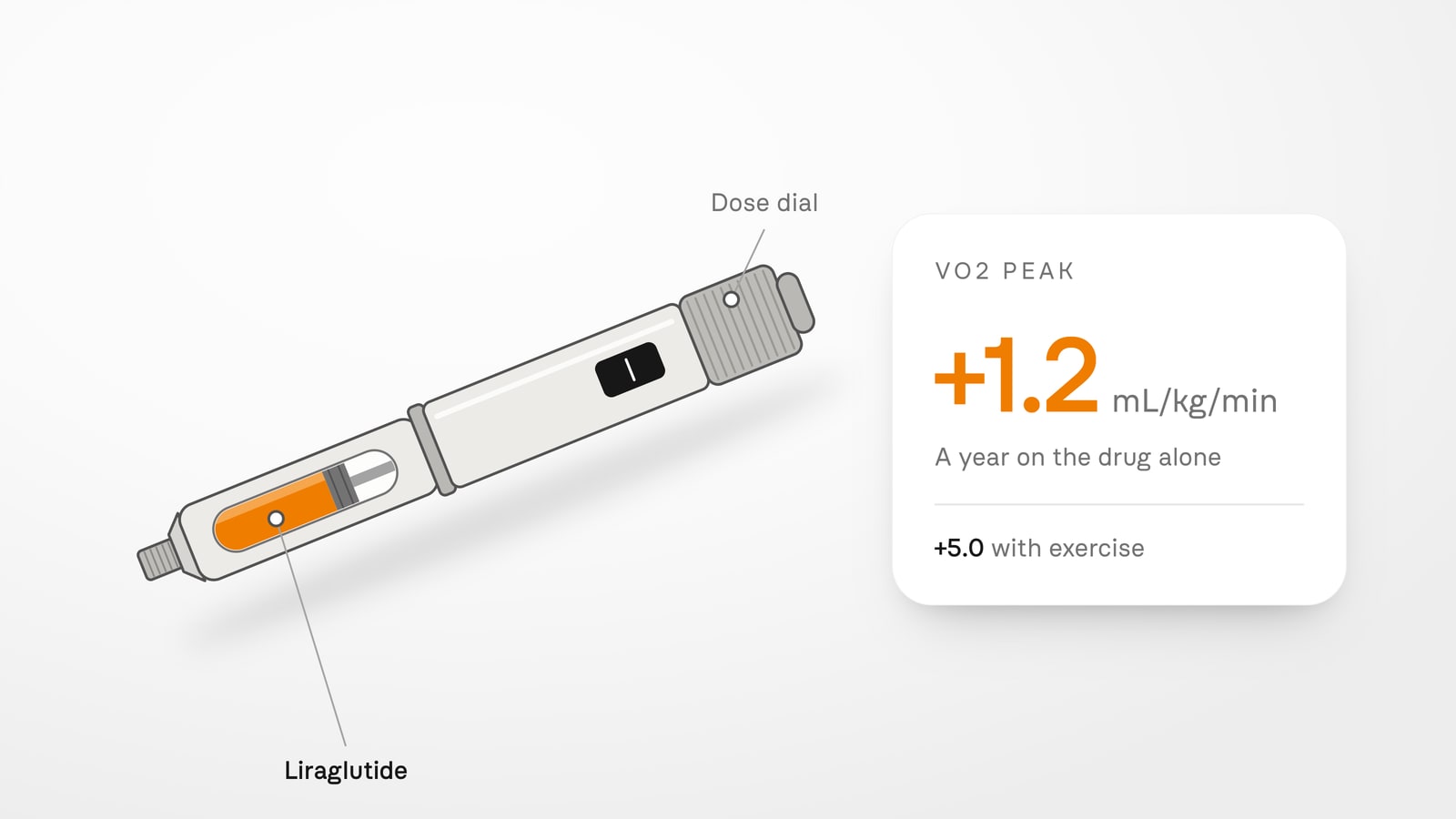
The same trial then tested the drug. A year on liraglutide alone didn't make people measurably fitter. Exercise did, with or without the drug1.
That matters because fitness tracks how long you live. In a study that followed 2,905 adults for 19 years, each 1 mL/min more oxygen per kg of fat-free mass came with a 16.2% lower risk of dying from any cause2.
What fitness means here
Fitness, in these studies, is your VO2 max or VO2 peak: the most oxygen your body can use at full effort. It depends on how much blood your heart can pump and how much oxygen your muscles can pull out of it3.
Why losing weight raises your VO2 max on paper
VO2 max is usually given per kg of body weight, in mL/kg/min. Divide the same oxygen by fewer kg and the number goes up, even if your heart and muscles haven't changed at all. Someone who can use 2,500 mL of oxygen a minute reads 22.7 mL/kg/min at 110 kg. At 97 kg, the same 2,500 mL reads 25.8.
That's what happened in the Danish trial's diet. VO2 max per kg of body weight rose by 2.0 mL/kg/min, or 8.6%. The most oxygen people could use fell by 4.5%, and their peak power on the bike fell by 2.8%1.
On the diet, VO2 max per kg rose while the body could do less
Change over the 8 week low calorie diet (%)
| VO2 max per kg of body weight | 8.6% |
|---|---|
| VO2 max per kg of fat-free mass | 3.6% |
| Peak power on the bike | −2.8% |
| Most oxygen used in a minute | −4.5% |
So the trial judged fitness per kg of fat-free mass. That measure moved far less during the diet, up 1.4 mL/kg/min or 3.6%, because people lost some fat-free mass too1. It is the fairer measure, and the 2,905 person study found it predicted death better than fitness per kg of body weight2.
If you're losing weight, look at the total oxygen your body can use, in mL a minute, or at fitness per kg of fat-free mass. A higher number per kg of body weight can just mean there is less of you.
What a year on the drug did
After the diet, the 193 adults with obesity were split into four groups for a year. They took liraglutide, followed an exercise programme, did both, or took a placebo1.
The exercise was two group sessions a week of interval cycling and circuit training, plus sessions on their own. People did a median of 2.65 sessions a week, 116 minutes in all, at 79% of their maximum heart rate1.
Only the groups who exercised got clearly fitter
Change in VO2 peak over a year (mL/min per kg of fat-free mass)
| Placebo | −1.1 |
|---|---|
| Exercise alone | 5 |
| Liraglutide alone | 1.2 |
| Liraglutide and exercise | 4.2 |
Fitness per kg of fat-free mass rose by 5.0 with exercise and 4.2 with exercise and the drug. On the drug alone it rose by 1.2, too little to be sure it moved at all. The placebo group lost 1.11.
Other measures showed the same. People who exercised, with or without the drug, climbed a set of stairs faster. On the drug alone, they didn't improve. In absolute terms, the exercise group used 378 mL a minute more oxygen at peak, and the drug alone group 73 mL, again too little to be sure of1.
There was one gain from the drug alone. Strength relative to body weight fell 7.8% on placebo but rose 1.0% on liraglutide, because people weighed less and kept their absolute strength. With exercise and the drug together, it rose 3.3%1.
Why the drug alone doesn't make you fitter
Losing fat takes load off your heart, and a 2025 review found GLP-1 drugs help blood sugar, weight and heart health in many ways. But it also found clinical studies have not shown these drugs improve fitness. Between 25% and 40% of the weight people lose on them comes from fat-free mass, the tissue that does the work when you exercise3.
Fitness comes from training your heart and muscles to deliver and use more oxygen. A drug that makes you eat less doesn't train either.
Where the evidence stops
The Danish trial used liraglutide, an older GLP-1. Semaglutide and tirzepatide cause more weight loss, and no trial like this one has tested their effect on fitness yet.
In people with heart failure and obesity, semaglutide did improve how far they could walk. In a trial of 529 people, they walked 21.5 m further in 6 minutes after a year, against 1.2 m on placebo4. When extra weight is what limits someone, losing it can help them move. A walking test is a different measure from VO2 max, though.
How to get fitter on a GLP-1
Do what the trial's exercise groups did. That means 2 to 3 sessions a week, close to 2 hours in total, much of it hard enough to reach about 80% of your maximum heart rate, with some circuit or strength work1. It improved fitness by about the same amount with the drug as without it.
Measure your fitness before you start and again after a few months. Watches are off by about 7 mL/kg/min on average for one person5, more than the change exercise made here, so use a lab test. See how accurate a watch's VO2 max is.
Personalise
Adjust
About you
Your plan
How we help
Stride, our VO2 max test, measures your fitness from the air you breathe, so you know your starting point and can see it change. Archie, our AI exercise physiologist, builds your cardio and strength sessions around your results. See lab testing to book a test, or meet Archie.
Get week 1 of your strength plan
Archie plans the strength sessions around your week.
- MonStrength · Full body45 min
- Goblet squat · 3 × 10
- Push-up · 3 × 8
- Dumbbell row · 3 × 10
- ThuStrength · Upper45 min
- SatStrength · Lower45 min
Citations
-
Jensen SBK, Fiorenza M, Juhl CR, et al. Physical fitness with exercise and GLP-1 receptor agonist treatment alone or combined after diet-induced weight loss: a secondary analysis of a randomized controlled trial in adults with obesity. Sports Med. 2026;56(7):1785-1800.
-
Imboden MT, Kaminsky LA, Peterman JE, et al. Cardiorespiratory fitness normalized to fat-free mass and mortality risk. Med Sci Sports Exerc. 2020;52(7):1532-1537.
-
Liu Z, Weeldreyer NR, Angadi SS. Incretin receptor agonism, fat-free mass, and cardiorespiratory fitness: a narrative review. J Clin Endocrinol Metab. 2025;110(10):2709-2717.
-
Kosiborod MN, Abildstrøm SZ, Borlaug BA, et al. Semaglutide in patients with heart failure with preserved ejection fraction and obesity. N Engl J Med. 2023;389(12):1069-1084.
-
Lambe R, Schumann M, Donnelly L, et al. Accuracy of VO2 max estimates from Apple Watch Series 10. Mayo Clin Proc Digit Health. 2026;4(2):100357.
How this article was reviewed
Medically reviewed by Dr Jack Close, last on . Every SPN Health article goes through three steps before it is published.
- Research checked against its source. Every number is matched to the paper it came from, and each study is weighed by its design, its size and power, who was studied, and where it was published.
- Findings matched to the physiology. Each finding is explained by what happens in the body, in health and in disease. A result that doesn't fit is explained or left out.
- Medical review by Dr Jack Close. A check that the article is clinically relevant and safe for the people reading it, and that its advice is something you can act on day to day.
This article explains the research and isn't personal medical advice. Speak to your doctor before making changes if you have a medical condition or take regular medication.