
In 1923, in Manchester, Archibald Hill collected runners' breath in bags as they ran harder and harder, and measured how much oxygen their bodies used. At some point it stopped rising, however hard they ran. That ceiling is VO2 max, and the only way to find it is to push to your absolute limit.
Your Apple Watch never does that. It reads your pulse and pace on everyday walks and runs, then draws a line up to the maximum heart rate expected for your age1.
Apple's own validation process never pushed users to VO2 max either. It tested the watch in 221 people against a lab test that stopped short of each person's limit, with the same kind of line drawn up to an age-based maximum1.
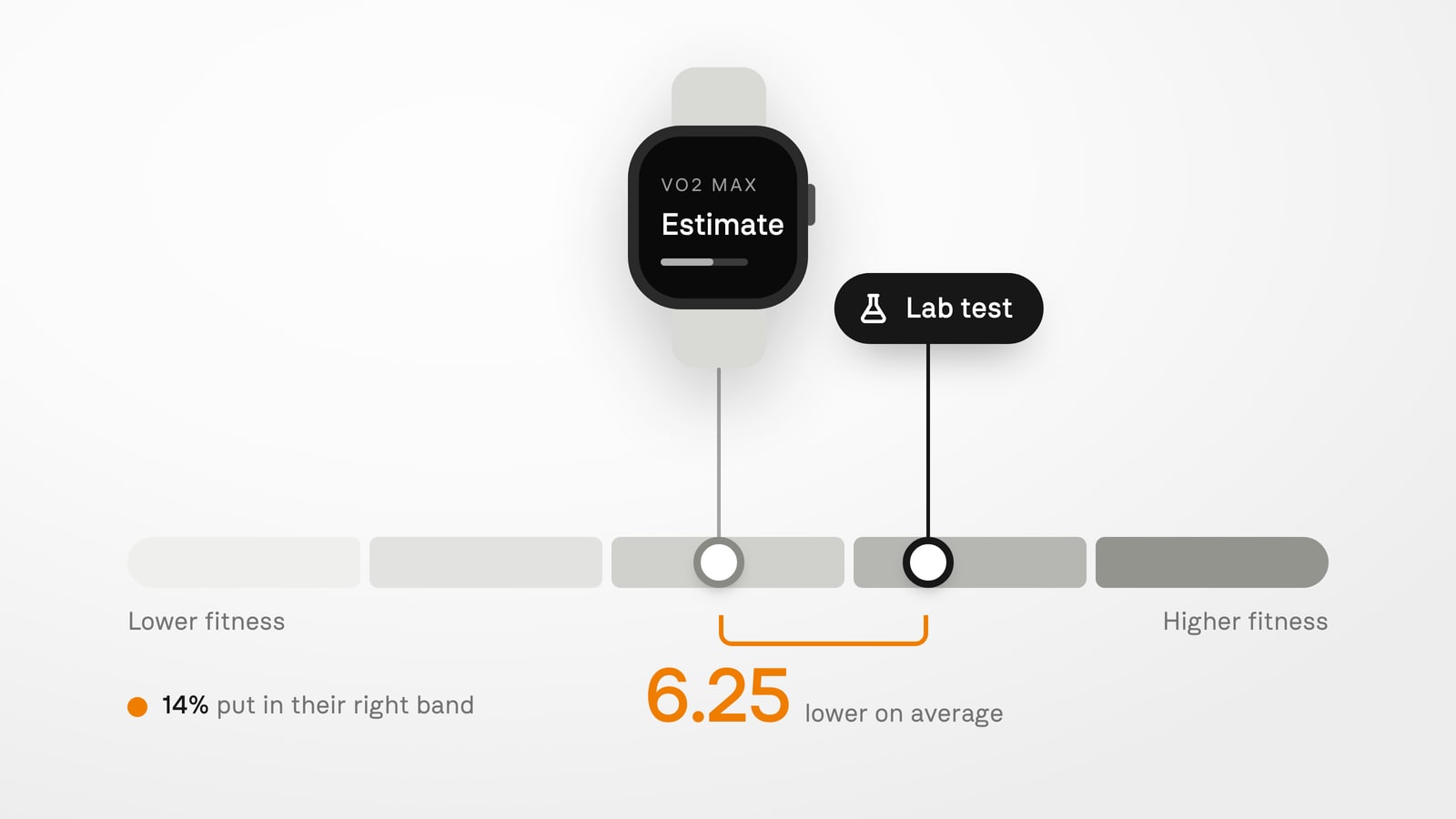
A watch that never sees your limit, checked against a test that never reached it, had no way of showing it was reading low. In 2026, independent researchers took 40 adults wearing the Apple Watch Series 10 to their actual limit with a real VO2 max test. The watch read 6.25 ml/kg/min too low on average, and 18 too low for one person2.
So if your watch says 38, your VO2 max could be 44 ml/kg/min. That gap is about what an inactive adult gains from 6 to 13 weeks of interval training3, so on average your watch puts you that much training behind your real fitness. Ultimately leaving you with no idea if the number has any validity whatsoever.
How your watch estimates VO2 max
VO2 max is the most oxygen your body can use in a minute, per kilogram of body weight. The oxygen you use each minute is the product of three things: your heart rate, the blood your heart pumps with each beat, and how much oxygen your muscles take out of that blood. At your maximum, the main limit is how much blood your heart can pump, and training raises VO2 max mostly by raising that4.
A lab measures VO2 max directly. You run or cycle to exhaustion while a mask measures the oxygen you breathe in and out, and the highest rate of oxygen your body uses is your VO2 max5.
Your watch never sees your breath. Of those three things, it measures one, your heart rate, with a light sensor on your wrist1. It works out the rest in three steps.
Step 1: your speed stands in for your oxygen
Walking or running on flat ground costs a fairly predictable amount of oxygen at a given speed. Exercise scientists have long used equations that predict it from speed and slope alone6. So the watch takes your speed from GPS and works out roughly how much oxygen that pace costs.
That is why Apple only makes an estimate from outdoor walks, runs and hikes, on ground under a 5% slope, with a good GPS signal1. On a treadmill there is no GPS speed, and on a hill the slope changes what each step costs.
Step 2: your heart rate says how hard that pace is for you
Between rest and your maximum, heart rate and oxygen use climb together in a straight line. In 63 adults tested on a bike, the share of their heart rate range they were using matched the share of their oxygen range almost exactly7. If a jog takes your heart rate 75% of the way from resting to maximum, it is using about 75% of your spare oxygen capacity.
A fitter heart pumps more blood each beat, so it needs fewer beats for the same pace4. A low heart rate at a given speed is what the watch reads as fitness.
Step 3: it draws the line out to your maximum
The watch now has points on that line, from rest and from your workouts. It extends the line up to your maximum heart rate and reads off the oxygen there. It doesn't need you to reach your maximum heart rate, but it does need a figure for it, which it takes from your age. It also needs you to work hard enough, raising your heart rate by about 30% of the range between resting and maximum1.
Apple doesn't publish its full model, which uses the watch's other sensors too. But this straight line projection is how Apple set the reference values in its own study. It took each person's heart rate and oxygen use from a submaximal lab test and drew the line out to their age-predicted maximum heart rate1.
A worked example
Take a 40-year-old with a resting heart rate of 60 bpm. The age formula puts their maximum at 180 bpm (208 minus 0.7 times 40)8. At rest, the body uses about 3.5 ml/kg/min of oxygen1. Say their usual jog costs 30 ml/kg/min and holds their heart rate at 150 bpm.
150 bpm is 90 beats above resting, out of a 120 beat range, so 75% of the way. The jog uses 26.5 ml/kg/min above resting. If that is 75% of the oxygen range, the full range is 35.3 ml/kg/min, and adding back the 3.5 at rest gives a VO2 max of 38.8 ml/kg/min.
Two numbers in that sum are assumptions, the oxygen cost of the pace and the maximum heart rate, and the error comes from them.
How far off it is
In the Series 10 study, the watch read 6.25 ml/kg/min low on average. For one person it could be 18.23 ml/kg/min too low or 5.73 ml/kg/min too high. The average error was 13.2%. It put 14% of people in their correct fitness band and another 34% one band away2.
An earlier test of an older Apple Watch in 30 people found almost the same thing: 6.07 ml/kg/min too low on average, and a 13.31% average error5.
Apple's own paper reported a much smaller gap, 1.4 ml/kg/min on average in 221 people. But its reference was the projection from step 3, not a measured maximum1. A watch checked against a projection shares that projection's assumptions, so the comparison can't show them.
Other brands do no better for one person. A review of 14 studies of wearables found the ones that estimate from exercise were right on average, but for one person they could be about 10 ml/kg/min off in either direction. Devices that estimate from resting data read 2.17 ml/kg/min high on average, and could be 13 to 17 ml/kg/min off9.
To see what a gap that size means at your age, compare it with what a good VO2 max is for your age.
Why your watch misses
Each step assumes something about you. When you differ from the average, the estimate moves.
Your maximum heart rate
The usual formula, 220 minus your age, had never been properly tested. A study that pooled 351 studies of 18,712 people found 208 minus 0.7 times your age fit better8. It is still an average. In 230 adults who did a maximal exercise test, the common formulas were close on average but could miss one person's maximum by 18 to 24 bpm in either direction10.
Go back to the 40-year-old. If their real maximum is 192 bpm, the jog used 68% of their range, and their VO2 max is 42.4 ml/kg/min. The watch says 38.8, so it reads 3.6 too low. If their real maximum is 168 bpm, their VO2 max is 35.3, and the watch reads 3.5 too high.
Worked example
Stop the line at the age formula's maximum and it reads 3.6 too low
- The watch's line, through rest and a jog, stopped at the guessed maximum of 180 bpm
- The same line carried on to a real maximum of 192 bpm
- 38.8: the watch's estimate, stopped at 180 bpm
- 42.4: the same line at a real maximum of 192 bpm
Oxygen use (ml/kg/min)
Heart rate (bpm)
| Series | Heart rate (bpm) | Oxygen use (ml/kg/min) |
|---|---|---|
| The watch's line, through rest and a jog, stopped at the guessed maximum of 180 bpm | 60 | 3.5 |
| The watch's line, through rest and a jog, stopped at the guessed maximum of 180 bpm | 150 | 30 |
| The watch's line, through rest and a jog, stopped at the guessed maximum of 180 bpm | 180 | 38.8 |
| The same line carried on to a real maximum of 192 bpm | 180 | 38.8 |
| The same line carried on to a real maximum of 192 bpm | 192 | 42.4 |
| the watch's estimate, stopped at 180 bpm | 38.8 | |
| the same line at a real maximum of 192 bpm | 42.4 |
Medicines that cap your heart rate do the same thing on a bigger scale. In Apple's study, people on beta blockers or calcium channel blockers who hadn't told the watch got estimates 11.8 ml/kg/min too high on average. Once they had, the error fell to 1.61.
What your pace costs you
The speed equations assume an average oxygen cost. People differ. At the same speed, a runner with good running economy uses less oxygen than one with poor economy11. If the 40-year-old's jog really costs 33 ml/kg/min, 10% above the average, their VO2 max is 42.8 ml/kg/min. The watch still says 38.8.
Work and heart rate the watch can't see
Apple's paper lists what else throws it off. A heavy backpack, carrying a child, or walking on sand adds work the watch can't detect, so your heart rate looks high for your speed and the estimate comes out low. Dehydration, caffeine, extreme heat and a recent move to altitude raise your heart rate and push it low too. So does an age, sex or weight entered wrongly in the Health app1.
What to do with your watch's number
Read it as a range. In the Series 10 study, the lab result was 6.25 ml/kg/min higher than the watch's on average, and for one person anywhere from 5.73 lower to 18.23 higher2. So if your watch says 38, a lab test would most likely put you near 44, within a range of about 32 to 56.
The trend is more useful than the number, within limits. In Apple's study, one person's repeat estimates varied by a median of 1.2 ml/kg/min1, so treat a smaller change as noise. Compare walks or runs on the same flat route at a similar effort, since slope and pace change what each step costs1. A hot month or a new medicine can move your heart rate, and the estimate with it, with no change in your fitness. Whether a watch can track one person's fitness over months hasn't been tested yet2.
If you take a beta blocker or a calcium channel blocker, say so in Health Details in the Health app. In Apple's study, that cut the error for people on those medicines from 11.8 to 1.6 ml/kg/min on average1.
How we help
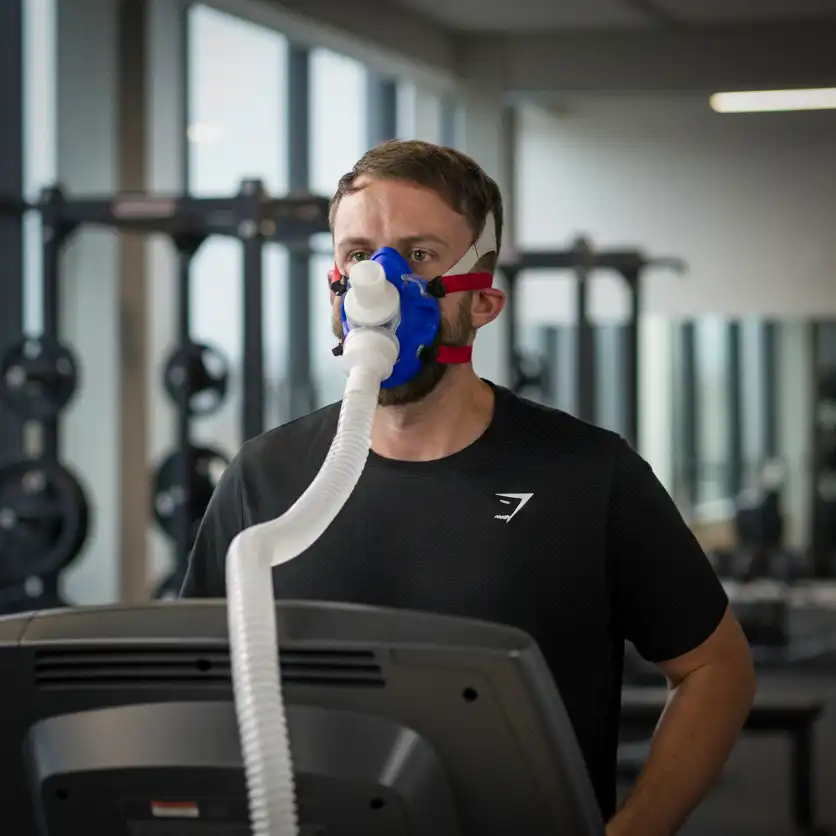
Stride, our VO2 max test, measures the two things your watch has to guess: the oxygen you use, from the air you breathe at every stage up to your maximum, and your real maximum heart rate. Archie, our AI exercise physiologist, builds your training from that number. See lab testing to book a test, or meet Archie.

VO2 Max
#1 Health PredictorYour body's maximum capacity to produce energy. One of the strongest predictors of how independently you'll live decades from now.
Your Limiter
There are three components that make up VO2 max: Lung function to pull in oxygen, heart function to pump it to your muscles, and muscle function to extract the oxygen from your blood.

Find out your real number
from £169A watch or a formula gives you a range. Stride measures your VO2 max, and Scan measures your fat, muscle and bone.
Citations
-
Apple. Using Apple Watch to estimate cardio fitness with VO2 max. May 2021.
-
Lambe R, Schumann M, Donnelly L, et al. Accuracy of VO2 max estimates from Apple Watch Series 10. Mayo Clin Proc Digit Health. 2026;4(2):100357.
-
Bacon AP, Carter RE, Ogle EA, et al. VO2max trainability and high intensity interval training in humans: a meta-analysis. PLoS One. 2013;8(9):e73182.
-
Bassett DR, Howley ET. Limiting factors for maximum oxygen uptake and determinants of endurance performance. Med Sci Sports Exerc. 2000;32(1):70-84.
-
Lambe R, O'Grady B, Baldwin M, Doherty C. Investigating the accuracy of Apple Watch VO2 max measurements: a validation study. PLoS One. 2025;20(5):e0323741.
-
Moore CC, Aguiar EJ, Ducharme SW, Tudor-Locke C. Development of a cadence-based metabolic equation for walking. Med Sci Sports Exerc. 2021;53(1):165-173.
-
Swain DP, Leutholtz BC. Heart rate reserve is equivalent to %VO2 reserve, not to %VO2max. Med Sci Sports Exerc. 1997;29(3):410-414.
-
Tanaka H, Monahan KD, Seals DR. Age-predicted maximal heart rate revisited. J Am Coll Cardiol. 2001;37(1):153-156.
-
Molina-Garcia P, Notbohm HL, Schumann M, et al. Validity of estimating the maximal oxygen consumption by consumer wearables: a systematic review with meta-analysis and expert statement of the INTERLIVE network. Sports Med. 2022;52(7):1577-1597.
-
Martin J, Lindsey B, Gerrity C, Ambegaonkar J. Exploratory analysis of the accuracy of age-based maximal heart rate equations across cardiorespiratory fitness levels. PLoS One. 2025;20(10):e0335842.
-
Barnes KR, Kilding AE. Running economy: measurement, norms, and determining factors. Sports Med Open. 2015;1(1):8.
How this article was reviewed
Medically reviewed by Dr Jack Close, last on . Every SPN Health article goes through three steps before it is published.
- Research checked against its source. Every number is matched to the paper it came from, and each study is weighed by its design, its size and power, who was studied, and where it was published.
- Findings matched to the physiology. Each finding is explained by what happens in the body, in health and in disease. A result that doesn't fit is explained or left out.
- Medical review by Dr Jack Close. A check that the article is clinically relevant and safe for the people reading it, and that its advice is something you can act on day to day.
This article explains the research and isn't personal medical advice. Speak to your doctor before making changes if you have a medical condition or take regular medication.