
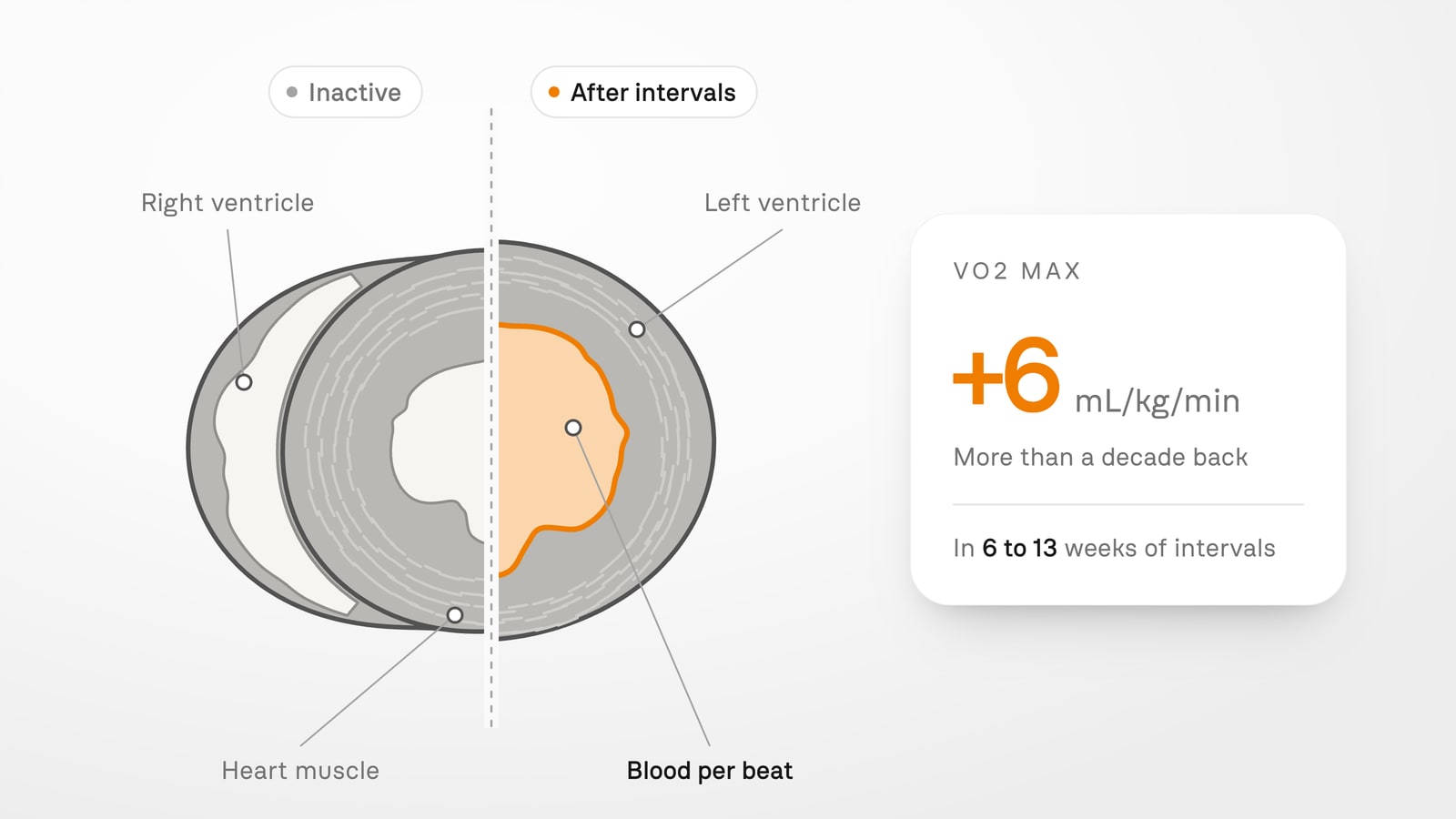
In Norway, researchers measured the VO2 max of 3,816 healthy adults on a treadmill, with a mask analysing every breath. Men in their 70s averaged 35.3 mL/kg/min, about a third less than men in their 20s at 54.4. Women in their 70s were about a third lower too1.
That looks like the price of getting older. But in a review of 37 training studies, inactive adults under 45 did 6 to 13 weeks of interval training, and their VO2 max rose by about 6 mL/kg/min for someone who weighs 80 kg2. On those Norwegian averages, that's more than a decade of the gap closed in a couple of months.
So your age sets the average you're compared with. It doesn't set where you have to sit. A good VO2 max is one above the average for your age and sex: about 47 mL/kg/min for a man in his 40s, and about 38 for a woman1.
What VO2 max measures
Your muscles run on oxygen. Every minute you breathe it in, your lungs pass it into your blood, your heart pumps that blood out, and your muscles pull the oxygen from it to make energy.
VO2 max is the most oxygen your body can use in one minute when you are working as hard as you can. It is written as millilitres of oxygen per kilogram of body weight per minute (mL/kg/min), so a light person and a heavy person can be compared on the same scale.
Three things set the number:
- How much blood your heart pumps with each beat, and how fast it can beat.
- How much oxygen your blood can carry.
- How much oxygen your muscles can take out of the blood and use.
Whichever runs out first sets your ceiling, and that ceiling is your VO2 max.
It is measured in a lab. You run on a treadmill or ride a bike wearing a mask that measures the air you breathe in and out, and the effort climbs until you can't go on. The highest oxygen use you reach is your VO2 max.
Why it falls with age
Your heart's top speed drops as you age, by about 6 beats a minute every decade1. A heart that beats fewer times a minute moves less blood, so less oxygen reaches your muscles. Muscle mass falls too, which leaves less tissue to use the oxygen.
A US registry of 22,379 lab tests found that, on the treadmill, VO2 max fell by an average of 13.5% per decade3. It doesn't fall at the same rate all your life. A study that tested the same people over about 8 years found it dropped by 3 to 6% per decade in their 20s and 30s, and by more than 20% per decade in their 70s4.
So the fitness you build in your 40s and 50s has to carry you through the decades when it falls fastest.
Average VO2 max by age
These are the averages from the largest European study of measured VO2 max, which tested 3,816 healthy men and women in Norway on a treadmill1.
Average VO2 max is about a third lower in your 70s than your 20s
- Men
- Women
Average VO2 max (mL/kg/min)
Age (start of each decade)
| Series | Age (start of each decade) | Average VO2 max (mL/kg/min) |
|---|---|---|
| Men | 20 | 54.4 |
| Men | 30 | 49.1 |
| Men | 40 | 47.2 |
| Men | 50 | 42.6 |
| Men | 60 | 39.2 |
| Men | 70 | 35.3 |
| Women | 20 | 43 |
| Women | 30 | 40 |
| Women | 40 | 38.4 |
| Women | 50 | 34.4 |
| Women | 60 | 31.1 |
| Women | 70 | 28.3 |
| Age | Men (mL/kg/min) | Women (mL/kg/min) |
|---|---|---|
| 20 to 29 | 54.4 | 43.0 |
| 30 to 39 | 49.1 | 40.0 |
| 40 to 49 | 47.2 | 38.4 |
| 50 to 59 | 42.6 | 34.4 |
| 60 to 69 | 39.2 | 31.1 |
| 70 and over | 35.3 | 28.3 |
These are averages, and people vary a lot around them. In each group, about two in three people sat within 5 to 9 points either side of the average. The people in the study were also healthy volunteers, likely fitter than the population as a whole, so the average person on the street sits a little lower.
What counts as good
Above the average for your age is good, and further above is better.
In a study that followed 122,007 adults for about 9 years, everyone had done a treadmill test at the Cleveland Clinic in Ohio. Their fitness was estimated from how far the treadmill took them, not measured with a mask. Those in the lowest fitness group were 5 times more likely to die during the study than those in the top group. Being below average rather than above average carried about the same extra risk as smoking or having type 2 diabetes5.
A review of 33 studies put a number on each step. Every 3.5 mL/kg/min of extra fitness came with a 13% lower risk of dying during follow-up. People below about 28 mL/kg/min had clearly higher risk than those above it6.
This is why the American Heart Association says fitness should be checked like a vital sign, alongside blood pressure and cholesterol7.
How much training can raise it
The review of 37 training studies looked at healthy adults under 45 who were inactive or only lightly active. Across the studies, VO2 max rose by an average of 0.51 litres per minute, which is where the 6 mL/kg/min for an 80 kg person comes from2.
The studies that used longer intervals saw bigger gains, and in those studies every participant improved.
Why the number on your watch is a guess
Most running watches show a VO2 max, which they estimate from your heart rate and pace.
A review of 14 studies tested those estimates against lab results. The best watches were right on average across a group. For a single person, their estimate could still be about 10 mL/kg/min too high or too low8. That is the gap between the average man in his 30s and the average man in his 60s.
A watch is useful for following your trend from week to week, but it can't tell you where you sit in the table.
Getting your real number
Stride, our VO2 max test, is the lab test described above: a treadmill or bike test in a breathing mask, building to a maximum effort, with your heart rate tracked the whole way. You get your VO2 max, and the heart rates your training zones are built on.
Archie, our AI exercise physiologist, then sets your training from those measured numbers, not from your age. See lab testing to book a test in Manchester or London.
Find out your real number
from £169A watch or a formula gives you a range. Stride measures your VO2 max, and Scan measures your fat, muscle and bone.
Citations
-
Loe H, Rognmo Ø, Saltin B, et al. Aerobic capacity reference data in 3816 healthy men and women 20-90 years. PLoS One. 2013;8(5):e64319.
-
Bacon AP, Carter RE, Ogle EA, et al. VO2max trainability and high intensity interval training in humans: a meta-analysis. PLoS One. 2013;8(9):e73182.
-
Kaminsky LA, Arena R, Myers J, et al. Updated reference standards for cardiorespiratory fitness measured with cardiopulmonary exercise testing: data from the Fitness Registry and the Importance of Exercise National Database (FRIEND). Mayo Clin Proc. 2022;97(2):285-293.
-
Fleg JL, Morrell CH, Bos AG, et al. Accelerated longitudinal decline of aerobic capacity in healthy older adults. Circulation. 2005;112(5):674-682.
-
Mandsager K, Harb S, Cremer P, et al. Association of cardiorespiratory fitness with long-term mortality among adults undergoing exercise treadmill testing. JAMA Netw Open. 2018;1(6):e183605.
-
Kodama S, Saito K, Tanaka S, et al. Cardiorespiratory fitness as a quantitative predictor of all-cause mortality and cardiovascular events in healthy men and women: a meta-analysis. JAMA. 2009;301(19):2024-2035.
-
Ross R, Blair SN, Arena R, et al. Importance of assessing cardiorespiratory fitness in clinical practice: a case for fitness as a clinical vital sign. Circulation. 2016;134(24):e653-e699.
-
Molina-Garcia P, Notbohm HL, Schumann M, et al. Validity of estimating the maximal oxygen consumption by consumer wearables: a systematic review with meta-analysis and expert statement of the INTERLIVE network. Sports Med. 2022;52(7):1577-1597.
How this article was reviewed
Medically reviewed by Dr Jack Close, last on . Every SPN Health article goes through three steps before it is published.
- Research checked against its source. Every number is matched to the paper it came from, and each study is weighed by its design, its size and power, who was studied, and where it was published.
- Findings matched to the physiology. Each finding is explained by what happens in the body, in health and in disease. A result that doesn't fit is explained or left out.
- Medical review by Dr Jack Close. A check that the article is clinically relevant and safe for the people reading it, and that its advice is something you can act on day to day.
This article explains the research and isn't personal medical advice. Speak to your doctor before making changes if you have a medical condition or take regular medication.