
The best endurance athletes in the world do about 80% of their sessions easy, below their first lactate threshold, with the lactate in their blood around 2 mmol per litre1. That's where zone 2 comes from.
Many people copy them with a watch. It takes 220, subtracts your age and calls 60 to 70% of the answer zone 2. But when researchers measured the first lactate threshold in 100 men and women, it landed anywhere from 60% to 90% of their maximum heart rate2.
So you can match the champions' easy hours, session for session, and still not be training where they train. Zone 2 is set by your own threshold, not your age, and a lab test can find it from your blood or your breathing.
How your muscles make energy
Your muscles burn two fuels: fat and carbohydrate.
At an easy pace they run mostly on fat, using oxygen. Fat holds a lot of energy but releases it slowly. As you push harder, your muscles need energy faster than fat can give it, so they burn more carbohydrate. In a well-known lab study, fat burning peaked at an average of 74% of maximum heart rate, and fell away to almost nothing above 92%3.
Burning carbohydrate fast produces lactate. At low effort your body clears lactate as quickly as it makes it, so the level in your blood stays low and steady.
What zone 2 actually is
As the effort climbs, you reach a point where the lactate in your blood first starts to rise above its resting level. This is your first lactate threshold.
Zone 2 is the band of effort just below that point. It is easy enough to hold for a long time and hard enough to train the systems that use oxygen and burn fat. It's the band the athletes at the start of this post spend most of their sessions in1.
Researchers who measure fat burning and lactate together found the two move in opposite directions: when lactate goes up, fat burning goes down4. That is why zone 2 is defined by your lactate, and why the edge of it is different for every person.
Where 220 minus age comes from
Many watches and apps don't measure your lactate. They estimate your maximum heart rate, then call zone 2 a fixed slice of it, often 60 to 70%.
The usual way to estimate maximum heart rate is 220 minus your age. A 2001 study pointed out that this formula had never been properly tested, especially in older adults. It pooled 351 studies covering 18,712 people and found a better fit was 208 minus 0.7 times your age5.
The two formulas give similar answers in middle age. For a 50 year old, 220 minus age gives 170 and the newer one gives 173. Both give the average for your age, and your own maximum can sit far from it.
Your real maximum heart rate
People of the same age have very different maximum heart rates. In a Norwegian study that measured it in 3,816 healthy adults, men in their 50s averaged 177 beats a minute, and about one in three of them sat more than 12 beats away from that6.
A 2020 study tested the common formulas, 220 minus age included, against maximum heart rates measured in a lab. All of them agreed poorly with the real number for individual people7.
So a 50 year old whose true maximum is 190 and one whose true maximum is 160 both get told 170. Their zone 2, at 60 to 70% of 170, comes out at 102 to 119 beats a minute for both of them.
Why even your true maximum isn't enough
Even a measured maximum heart rate won't find your zone 2 reliably if you take a fixed percentage of it.
In the study of 100 men and women, each person's first lactate threshold was measured from their blood. For one person 70% of maximum heart rate was well below it. For another it was above it2.
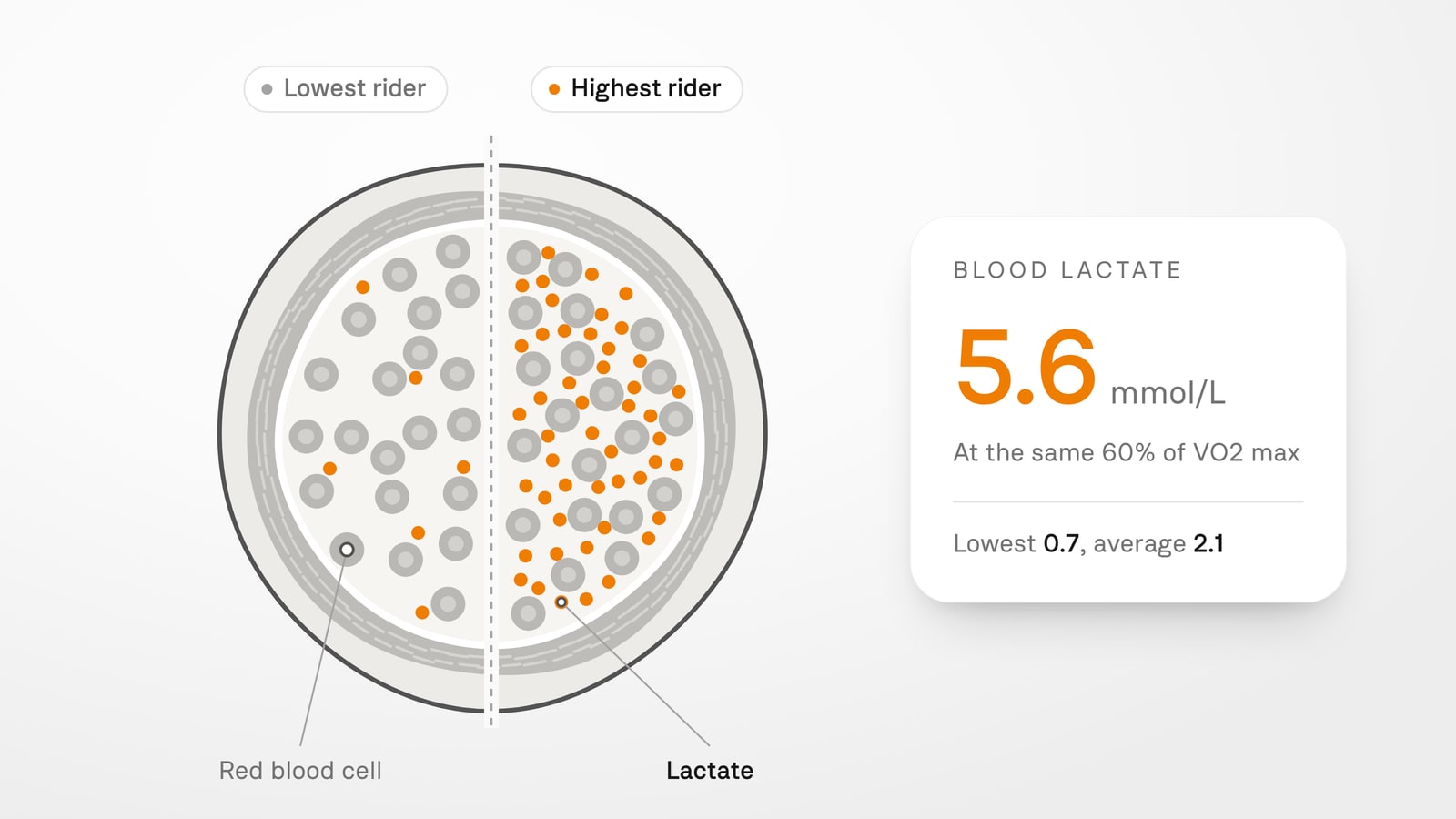
A second study held 21 fit men at the same share of their VO2 max for an hour on a bike. At 60% of VO2 max their blood lactate averaged 2.1 mmol per litre, but ranged from 0.7 to 5.6, an easy ride for some and a hard one for others8.
At the same 60% of VO2 max, one rider's lactate was 8 times another's
Blood lactate during the hour (mmol per litre)
| Lowest rider | 0.7 |
|---|---|
| Average | 2.1 |
| Highest rider | 5.6 |
How to find your real zone 2
The reliable way to know where your threshold sits is to measure it, and there are two ways to do that. One takes small blood samples as the effort climbs and finds where lactate starts to rise. The other analyses the air you breathe. As the effort climbs there's a point where your breathing starts to rise faster than your oxygen use. That's your first ventilatory threshold, and endurance research uses it as the same boundary as the first lactate threshold, at a blood lactate of about 2 mmol per litre1.
Stride, our VO2 max test, uses your breathing. It doesn't take blood. On a treadmill or a bike in a breathing mask, it finds your first ventilatory threshold and your heart rate there, and shows how much fat and carbohydrate you burn at each heart rate. Archie, our AI exercise physiologist, then sets your zone 2 from 85% of that heart rate up to it, instead of 220 minus your age, and updates it when you retest. See lab testing to book a test in Manchester or London, or meet Archie.

Find out your real number
from £169A watch or a formula gives you a range. Stride measures your VO2 max, and Scan measures your fat, muscle and bone.
Citations
-
Seiler S. What is best practice for training intensity and duration distribution in endurance athletes? Int J Sports Physiol Perform. 2010;5(3):276-291.
-
Iannetta D, Inglis EC, Mattu AT, et al. A critical evaluation of current methods for exercise prescription in women and men. Med Sci Sports Exerc. 2020;52(2):466-473.
-
Achten J, Gleeson M, Jeukendrup AE. Determination of the exercise intensity that elicits maximal fat oxidation. Med Sci Sports Exerc. 2002;34(1):92-97.
-
San-Millán I, Brooks GA. Assessment of metabolic flexibility by means of measuring blood lactate, fat, and carbohydrate oxidation responses to exercise in professional endurance athletes and less-fit individuals. Sports Med. 2018;48(2):467-479.
-
Tanaka H, Monahan KD, Seals DR. Age-predicted maximal heart rate revisited. J Am Coll Cardiol. 2001;37(1):153-156.
-
Loe H, Rognmo Ø, Saltin B, et al. Aerobic capacity reference data in 3816 healthy men and women 20-90 years. PLoS One. 2013;8(5):e64319.
-
Shookster D, Lindsey B, Cortes N, et al. Accuracy of commonly used age-predicted maximal heart rate equations. Int J Exerc Sci. 2020;13(7):1242-1250.
-
Scharhag-Rosenberger F, Meyer T, Gässler N, et al. Exercise at given percentages of VO2max: heterogeneous metabolic responses between individuals. J Sci Med Sport. 2010;13(1):74-79.
How this article was reviewed
Medically reviewed by Dr Jack Close, last on . Every SPN Health article goes through three steps before it is published.
- Research checked against its source. Every number is matched to the paper it came from, and each study is weighed by its design, its size and power, who was studied, and where it was published.
- Findings matched to the physiology. Each finding is explained by what happens in the body, in health and in disease. A result that doesn't fit is explained or left out.
- Medical review by Dr Jack Close. A check that the article is clinically relevant and safe for the people reading it, and that its advice is something you can act on day to day.
This article explains the research and isn't personal medical advice. Speak to your doctor before making changes if you have a medical condition or take regular medication.