
The protein number you've most likely seen, 1.6 g for every kg you weigh, comes from a 2018 review of 49 trials in 1,863 healthy adults who were lifting weights. Past about 1.62 g per kg a day, extra protein added no more fat-free mass1. Yet in 2025, four medical and nutrition societies warned that working protein out from your weight can significantly overestimate what you need if you have obesity2.
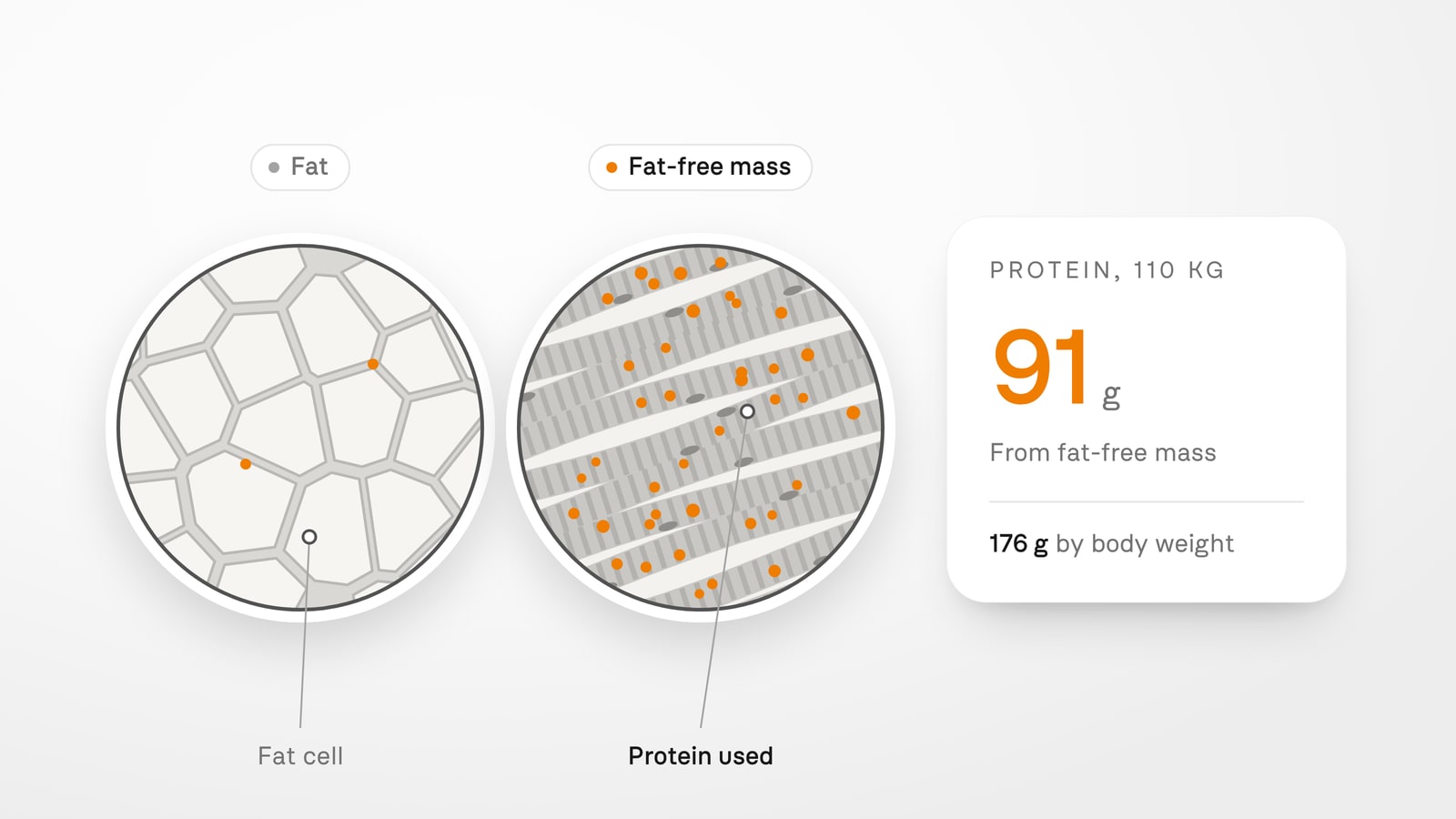
Take someone who weighs 110 kg at 45% body fat, losing weight on a GLP-1. By weight, that's 176 g a day. The societies' figure is 1.5 g per kg of fat-free mass, and they have 60.5 kg of it, so about 91 g2. Now take an 80 kg lifter at 12% body fat, cutting to get leaner. By weight, 128 g. A review of lean lifters eating less than they burn put their need at 2.3 to 3.1 g per kg of fat-free mass, or 162 to 218 g3.
The rule is wrong in both directions because it counts your fat, and fat tissue uses little protein4. So set your protein from your fat-free mass. If you carry fat, the number comes down. If you're lean and cutting, it goes up.
Why fat-free mass sets your protein need
Your body's protein sits in your muscle, organs, bone, blood and skin. That tissue is broken down and rebuilt every day, and the protein you eat pays for the rebuilding. Fat tissue is mostly stored fat and uses little. So lean mass, not body weight, drives how much protein you need4.
That's why one amount of protein means such different things to different people. Across three groups of adults and patients, the same 60 g a day worked out at anywhere from 0.83 to 1.77 g per kg of lean mass, depending on whose body it was4. For one person 60 g was more than double what it was for another.
Where 1.6 g per kg comes from
The 49 trials in the 2018 review tested protein supplements alongside strength training, in healthy adults. Gains in fat-free mass levelled off once total protein passed about 1.62 g per kg of body weight a day. Protein helped less as people got older, and more in people already trained1.
Those trials measured protein per kg of body weight. They didn't ask how much of each person's weight was fat, so the number doesn't carry over to someone whose weight is made up very differently from a healthy lifter's.
How far apart the methods land
Fat-free mass is your weight minus your fat. A DEXA scan measures it.
| 110 kg, 45% body fat, goal 80 kg | 80 kg, 12% body fat, cutting | |
|---|---|---|
| Fat-free mass | 60.5 kg | 70.4 kg |
| 1.6 g per kg of current weight | 176 g a day | 128 g a day |
| 1.6 g per kg of goal weight | 128 g a day | 128 g a day |
| From fat-free mass | 91 g a day (1.5 g per kg) | 162 to 218 g a day (2.3 to 3.1 g per kg) |
The gap shows up in real people too. In a study of 2,291 adults whose fat-free mass was measured, a target from body weight and one from fat-free mass differed by a clinically relevant amount in 78% to 100% of those with overweight or obesity5.
Why your goal weight doesn't fix it
Using a goal weight, or a "corrected" weight, is the usual workaround. In the same study, a corrected weight still overestimated protein needs in 48% to 92% of people who were underweight, a healthy weight or overweight. The authors called the differences "unacceptably large"5.
The advisory says it's unclear whether protein should be set from actual weight, a corrected weight or fat-free mass. It calls fat-free mass the more accurate choice, if you know your body composition2.


Body Composition
The scale shows one number. We split it into the three numbers that really matter.
From Mar ’26 to Jul ’26: weight −12.0 kg, lean −3.0 kg, fat −8.9 kg, bone −0.1 kg.
Where the evidence stops
No trial has compared how much muscle people keep on a target from fat-free mass against one from body weight. The 2,291-person study showed how far apart the two land, and its authors say it's still unknown which is best5. The 1.5 g figure is the advisory's choice. The analysis that found 60 g so uneven put the average need a little higher, at 1.63 g per kg of lean mass4. Both start from lean mass, and both come out far below 1.6 g per kg of body weight for someone carrying a lot of fat.
What to do with it
If you're losing weight, work your target out from your latest scan, not the scale. In the main tirzepatide trial, body weight fell 21.3% over 72 weeks and lean mass 10.9%6. For the 110 kg person above, that takes the fat-free mass target from 91 g to about 81 g. A target from current weight would have fallen from 176 g to 139 g, still well above it.
If you're lean and cutting, go above the body-weight number. The leaner you are and the bigger your deficit, the nearer the top of 2.3 to 3.1 g per kg of fat-free mass you need3. That includes bodybuilders getting ready for a show. An update of that review pooled 29 studies of trained people losing fat while they lifted. The more protein they ate, the more fat-free mass they kept. The link was strongest with protein counted per kg of fat-free mass, and in men, leaner people and diets longer than 4 weeks7. The authors call the result exploratory, because the studies differed so much.
So if you've been given 2 to 2.5 g per kg of lean mass for a cut, stay near the top of it. For the 80 kg lifter above, that range is 141 to 176 g a day, and its bottom falls short of the 162 g where the review's range starts3.
If you have no scan yet, the advisory suggests a fixed 80 to 120 g a day, and advises against staying at 2 g per kg of body weight or more for long periods2.
How we help
Working your protein out from fat-free mass needs your fat-free mass, and that's the number we measure.
Scan, our DEXA scan, splits your weight into fat, lean mass and bone, so you can work your protein out from your own fat-free mass. Say you weigh 95 kg and your scan shows 57 kg of fat-free mass. At 1.5 g per kg, that's 86 g a day, against 152 g from body weight. Scan again as the weight comes off and work it out from the new number.
Archie, our AI exercise physiologist, compares each scan with your last, so you can see whether the fat-free mass your target rests on is holding. It builds your strength sessions too, and adjusts them after every one you log.
You can book a test in Manchester or London, or meet Archie.

Losing weight? Check how much muscle you carry.
Weight loss can take muscle as well as fat. Estimate your muscle, body fat and visceral fat for your age in two minutes.
- Muscle
- Body fat
- Visceral fat
Citations
-
Morton RW, Murphy KT, McKellar SR, et al. A systematic review, meta-analysis and meta-regression of the effect of protein supplementation on resistance training-induced gains in muscle mass and strength in healthy adults. Br J Sports Med. 2018;52(6):376-384.
-
Mozaffarian D, Agarwal M, Aggarwal M, et al. Nutritional priorities to support GLP-1 therapy for obesity: a joint Advisory from the American College of Lifestyle Medicine, the American Society for Nutrition, the Obesity Medicine Association, and The Obesity Society. Obesity. 2025;33(8):1475-1503.
-
Helms ER, Zinn C, Rowlands DS, Brown SR. A systematic review of dietary protein during caloric restriction in resistance trained lean athletes: a case for higher intakes. Int J Sport Nutr Exerc Metab. 2014;24(2):127-138.
-
Geisler C, Prado CM, Müller MJ. Inadequacy of body weight-based recommendations for individual protein intake: lessons from body composition analysis. Nutrients. 2017;9(1):23.
-
Dekker IM, van Rijssen NM, Verreijen A, et al. Calculation of protein requirements; a comparison of calculations based on bodyweight and fat free mass. Clin Nutr ESPEN. 2022;48:378-385.
-
Look M, Dunn JP, Kushner RF, et al. Body composition changes during weight reduction with tirzepatide in the SURMOUNT-1 study of adults with obesity or overweight. Diabetes Obes Metab. 2025;27(5):2720-2729.
-
Refalo MC, Trexler ET, Helms ER. Effect of dietary protein on fat-free mass in energy restricted, resistance-trained individuals: an updated systematic review with meta-regression. Strength Cond J. 2026;48(4):398-412.
How this article was reviewed
Medically reviewed by Dr Jack Close, last on . Every SPN Health article goes through three steps before it is published.
- Research checked against its source. Every number is matched to the paper it came from, and each study is weighed by its design, its size and power, who was studied, and where it was published.
- Findings matched to the physiology. Each finding is explained by what happens in the body, in health and in disease. A result that doesn't fit is explained or left out.
- Medical review by Dr Jack Close. A check that the article is clinically relevant and safe for the people reading it, and that its advice is something you can act on day to day.
This article explains the research and isn't personal medical advice. Speak to your doctor before making changes if you have a medical condition or take regular medication.