
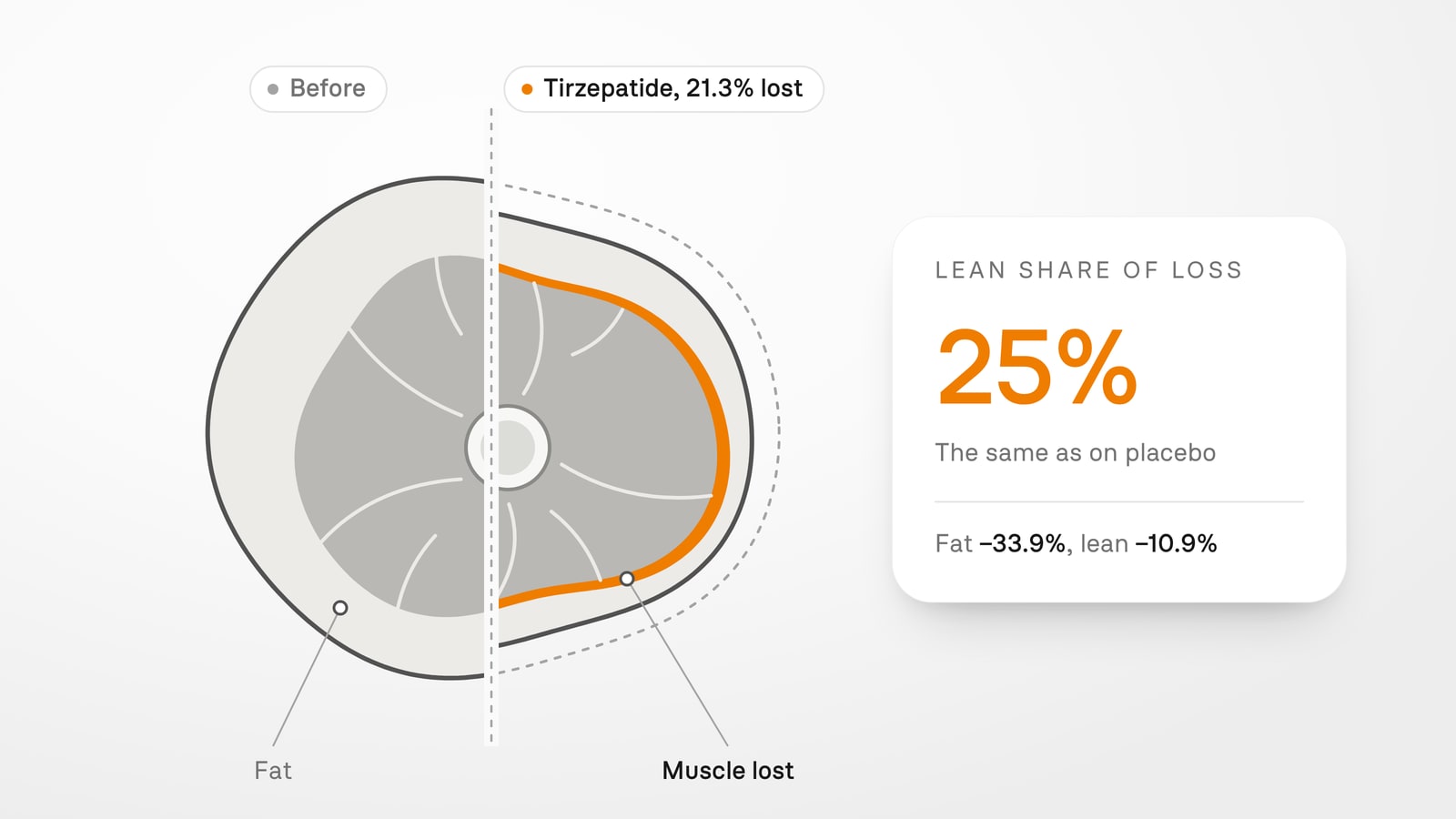
In the main trial of tirzepatide (mounjaro), 160 people had a DEXA scan before they started and again 72 weeks later. Those on the drug lost 21.3% of their body weight, and about a quarter of what they lost was lean mass, which includes your muscle1.
It's easy to read that as the drug eating muscle. But the people on the placebo, who lost far less weight, lost the same split: about 75% fat and 25% lean1.
So the drug didn't take a bigger share of muscle. It made people lose more weight, and any weight loss takes some lean tissue with it. Lose 20 kg and about 5 kg of it won't be fat. Strength training and enough protein keep more of that lean part, and a DEXA scan shows whether they're working.
What your weight is made of
A bathroom scale gives you one number, but your body has three parts:
- Fat mass, the fat under your skin and the fat packed around your organs.
- Bone.
- Lean mass, which is everything else: your muscle, and also your organs, your blood and the water in your body.
So lean mass and muscle are different things. When a study says someone lost lean mass, some of it is muscle and some of it is water, organ tissue and other things2.
A DEXA scan splits your weight into fat, lean mass and bone, and shows where each one sits. That is how the trials below measured it.
Why any weight loss takes some muscle
To lose weight you have to eat less energy than you burn. Your body makes up the gap by breaking down its own tissue. It takes mostly fat, but it takes some lean tissue too.
Any diet does this. In the tirzepatide trial, the people on the placebo lost far less weight. But of what they did lose, about 75% was fat and 25% was lean mass. That is the same split as the people on the drug1.
So in that trial the drug didn't change the share of lean mass people lost. It made them lose more weight, and more weight meant more lean mass in total.
How much lean mass GLP-1s take
In the tirzepatide trial, 160 people had DEXA scans before and after 72 weeks. On the drug, their weight fell by 21.3%. Their fat mass fell by 33.9% and their lean mass by 10.9%1.
Other trials of GLP-1 drugs have reported very different shares. In some, lean mass made up 40 to 60% of the weight lost. In others it was about 15% or less2. Who was studied, which drug they took and their other health conditions all change the result.
Does losing lean mass matter?
A 2024 review looked at MRI studies, which measure muscle more directly than DEXA. It found the muscle people lost on these drugs was in line with what you would expect from their age and the weight they lost. The fat inside the muscle also fell, which improves muscle quality2.
The same review flagged older people and people with more serious health problems as the groups to watch. They have less muscle to spare, and losing more raises their risk of sarcopenia, where muscle loss starts to limit strength and everyday function2.
What happens to your bones
In a Danish trial, people on liraglutide alone lost bone density at the hip and spine compared with people who only exercised. People who took liraglutide and also exercised lost no more bone density than the placebo group, even though they lost the most weight3.
How to keep more muscle
Lift weights
In a trial of older adults on a diet, people in all three exercise groups lost about 9% of their body weight. Those who did only aerobic exercise lost 5% of their lean mass. Those who did strength training, alone or with aerobic exercise, lost 2 to 3%4. They also kept more bone at the hip.
On the same diet, lifting weights kept more lean mass
Change in lean mass over 6 months (%)
| Aerobic training | −5% |
|---|---|
| Strength training | −2% |
| Aerobic and strength training | −3% |
Eat enough protein
In one trial, people on a steep diet who trained hard and ate 2.4 g of protein per kg of body weight a day gained 1.2 kg of lean mass. Those eating 1.2 g per kg gained 0.1 kg5. A review of 49 strength training studies found muscle gains levelled off at about 1.6 g per kg a day6. For someone who weighs 90 kg, 1.6 g per kg is 144 g of protein a day.
Measure it
A scale can't tell you whether the weight you lost was fat or muscle. A DEXA scan before you start and every few months after shows the split, so you can change your training before you lose too much.
What happens when you stop
The drugs work while you take them. In the semaglutide trial's follow-up, people lost 17.3% of their body weight over 68 weeks. A year after stopping, they had regained 11.6 percentage points of it, about two thirds of what they lost7.
Exercise is one of the few habits that protects both your muscle and your bone, and it stays with you after the drug stops34.
How we help
Scan, our DEXA scan, shows how much of your weight loss is fat, lean mass and bone, and how that changes from scan to scan. Archie, our AI exercise physiologist, builds your strength training around your scan, so more of what you lose is fat. See lab testing to book a scan in Manchester or London, or meet Archie.

Losing weight? Check how much muscle you carry.
Weight loss can take muscle as well as fat. Estimate your muscle, body fat and visceral fat for your age in two minutes.
- Muscle
- Body fat
- Visceral fat
Citations
-
Look M, Dunn JP, Kushner RF, et al. Body composition changes during weight reduction with tirzepatide in the SURMOUNT-1 study of adults with obesity or overweight. Diabetes Obes Metab. 2025;27(5):2720-2729.
-
Neeland IJ, Linge J, Birkenfeld AL. Changes in lean body mass with glucagon-like peptide-1-based therapies and mitigation strategies. Diabetes Obes Metab. 2024;26 Suppl 4:16-27.
-
Jensen SBK, Sørensen V, Sandsdal RM, et al. Bone health after exercise alone, GLP-1 receptor agonist treatment, or combination treatment: a secondary analysis of a randomized clinical trial. JAMA Netw Open. 2024;7(6):e2416775.
-
Villareal DT, Aguirre L, Gurney AB, et al. Aerobic or resistance exercise, or both, in dieting obese older adults. N Engl J Med. 2017;376(20):1943-1955.
-
Longland TM, Oikawa SY, Mitchell CJ, et al. Higher compared with lower dietary protein during an energy deficit combined with intense exercise promotes greater lean mass gain and fat mass loss: a randomized trial. Am J Clin Nutr. 2016;103(3):738-746.
-
Morton RW, Murphy KT, McKellar SR, et al. A systematic review, meta-analysis and meta-regression of the effect of protein supplementation on resistance training-induced gains in muscle mass and strength in healthy adults. Br J Sports Med. 2018;52(6):376-384.
-
Wilding JPH, Batterham RL, Davies M, et al. Weight regain and cardiometabolic effects after withdrawal of semaglutide: the STEP 1 trial extension. Diabetes Obes Metab. 2022;24(8):1553-1564.
How this article was reviewed
Medically reviewed by Dr Jack Close, last on . Every SPN Health article goes through three steps before it is published.
- Research checked against its source. Every number is matched to the paper it came from, and each study is weighed by its design, its size and power, who was studied, and where it was published.
- Findings matched to the physiology. Each finding is explained by what happens in the body, in health and in disease. A result that doesn't fit is explained or left out.
- Medical review by Dr Jack Close. A check that the article is clinically relevant and safe for the people reading it, and that its advice is something you can act on day to day.
This article explains the research and isn't personal medical advice. Speak to your doctor before making changes if you have a medical condition or take regular medication.